
- Type d'événement
- Appel à communications
- Début
- 15 décembre 2026
- Fin
- 20 mars 2027
- Modalité de présence
- En personne
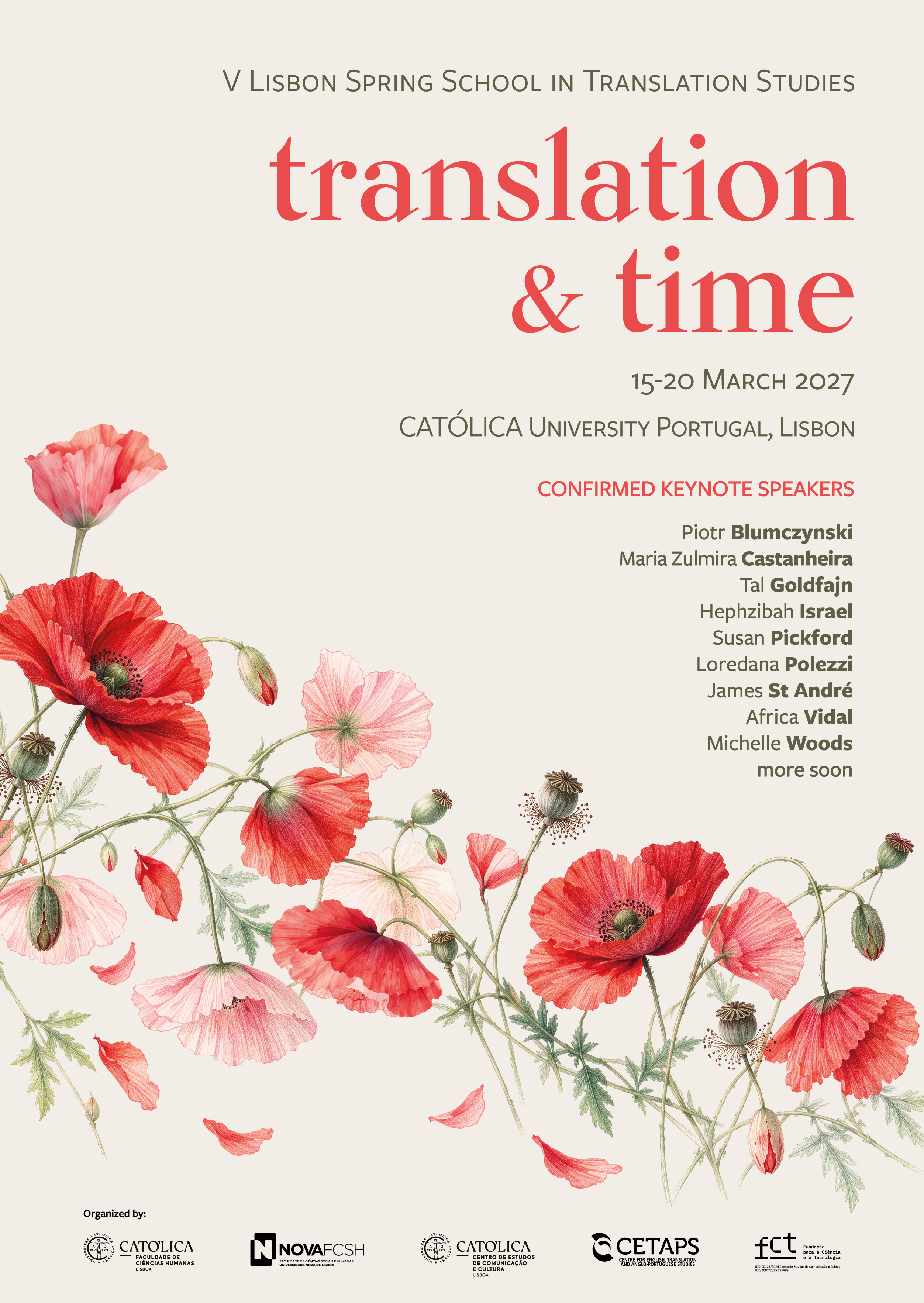
Call for papers:
"V Lisbon Spring School in Translation Studies
translation & time"
Dates: 15–20 March 2027
Venue: Faculdade de Ciências Humanas – Universidade Católica Portuguesa
The 5th edition of the Spring School in Translation Studies will focus on the manifold connections between translation and time. Time is inescapably constitutive of human experience – human beings are ‘martyred slaves of Time,’ as Baudelaire rather grimly puts it, and to not feel ‘the horrible burden of time,’ human beings would need to be drunk ‘on wine, poetry or virtue’.
Like any human endeavour, translation does not escape the pangs of time, but how does it articulate / produce / is produced by time? Since it is conventionally perceived as what comes after, we will examine how it deploys / re-presents / embodies / does justice to the different temporalities of source texts.
Furthermore, recent and age-old experiences in creative translation encourage us to view the world as a collection of 'translations of translations of translations', as Octavio Paz aptly formulated it in 1971. This perspective may dispel or, conversely, reinforce what we might call the anxiety of origin(ality). Different practices, such as indirect translation, pseudotranslation and adaptation, as well as transit between languages and cultures and their changing metaphors, point to an ongoing debate about the relationship between translation and time.
Conversely, contemporary phenomena such as (forced and voluntary) mobility across space, and the resulting experiences of overlapping temporalities involved in the deployment of travel, communication and power technologies, have intensified the porous nature of cultures and languages.
Current conceptualisations of translation highlight its pervasiveness across languages, literatures and cultures, as well as its interwovenness with time, the human body and memory. The concepts of 'prismatic translation' (Reynolds et al., 2020), 'ubiquitous translation' (Blumczynski, 2016), 'translationality' (Robinson, 2017; Blumczynski, 2023) and 'vertical translation' (Chunshen Zhu, 2005), among others, have both expanded and complicated the understanding of what translation is and does.
For this year’s Spring School, we would like to follow suit and get drunk on translation, i.e., to discuss present and past understandings and practices of translation, contemporary challenges to human translation as a temporal endeavour, as well as the dream of the immediate, and timeless, machine translation, among other possible topics.
The Lisbon Spring School in Translation Studies provides an open space for the exchange of ideas, methods and best practices within the field. Its overarching topics are deliberately broad to include as many doctoral topics, methods and approaches as possible. Inclusivity is not just a buzzword; it stems from the belief that knowledge must be shared to be productive and that differences of opinion, approach or method should bring scholars together for a 'conversational encounter' (Oakeshott, 1989), rather than divide them.
Therefore, we invite all doctoral students and early-career researchers from around the world to submit their ongoing work and to discuss the centrality of the notion and experience of ‘time’ in translation practices and conceptualizations. Ideally, this week-long event will highlight contemporary research interests and paths, resulting in a tentative mapping of an inclusive and plural field from the perspective of emerging scholars and their fresh insights and inputs.
The Spring School is a six-day event, comprising lectures by national and international scholars, paper sessions (PhD students and early career researchers) and poster sessions (MA students), translation workshops, and a cultural programme.
We welcome contributions on:
- translation, memory and memorialization;
- translation and the archive, translation as archive;
- translation history, ideology and narrative;
- activism in translation throughout time;
- mis/translation and time – causes and effects in the production of images of the self and of others;
- creativity in translation across the ages;
- translation and death;
- translation ethics;
- translation, contingency and risk;
- (un)translatability – competing definitions and practices;
- translation and/as resistance to dominant models and ideologies;
- translation as oppressive or emancipatory practice in different eras;
- imagining others in (pseudo)translation – from fear to inclusion via exoticization;
- prizes, power and politics in translation;
- translation policies in different periods;
- silence in/of translation;
- non-human translation and the illusion of timelessness;
- paratextuality as an imaginative resource; and
- the creative interplay of TS and knowledge production in other fields of inquiry, such as Literary Studies, Culture Studies, Cognitive Studies, Media Studies, History, Philosophy, as well as the hard sciences.
Other topics are also welcome.
Confirmed Speakers:
Piotr Blumczynski | Queen’s University Belfast
Maria Zulmira Castanheira | Nova University, Lisbon
Tal Goldfajn | University of Massachusetts Amherst
Hephzibah Israel | University of Edinburgh
Susan Pickford | Université de Genève
Loredana Polezzi | Stony Brook University
Annaleen Spiessens | Ghent University
James St André | The Chinese University of Hong Kong
Africa Vidal | University of Salamanca
Michelle Woods | SUNY New Paltz
Workshops:
Pseudotranslation – Annikó Sohar | Pázmány Péter Catholic University
Translation and archival practices – tba
Organizing Committee:
Karen Bennett | Alexandra Lopes
Scientific Committee:
Ana Margarida Abrantes | Karen Bennett | João Brogueira | Rita Bueno Maia | Maria Conceição Castel-Branco | Jane Duarte | Peter Hanenberg | Alexandra Lopes | Ana Matoso | Joana Moura | Marco Neves | Isabel Oliveira | Hanna Pięta.
Comment soumettre des propositions
Abstracts should be sent to [email protected] no later than 15 December 2026 and include paper title, abstract in English (max. 250 words), 3-4 keywords, name, e-mail address, institutional affiliation, and a brief bio (max. 100 words).
Important dates:
Deadline for abstract submission: 15 December 2026
Notification of acceptance: 10 January 2027
Early bird registration: 10 January - 30 January 2027 [€350]
Late registration: no later than 20 February 2027 [€500]
Frais d'inscription
Fee: €350 (includes lunches, coffee breaks, materials, and closing lunch)
Free for CECC and CETAPS members – fee for closing lunch is €45