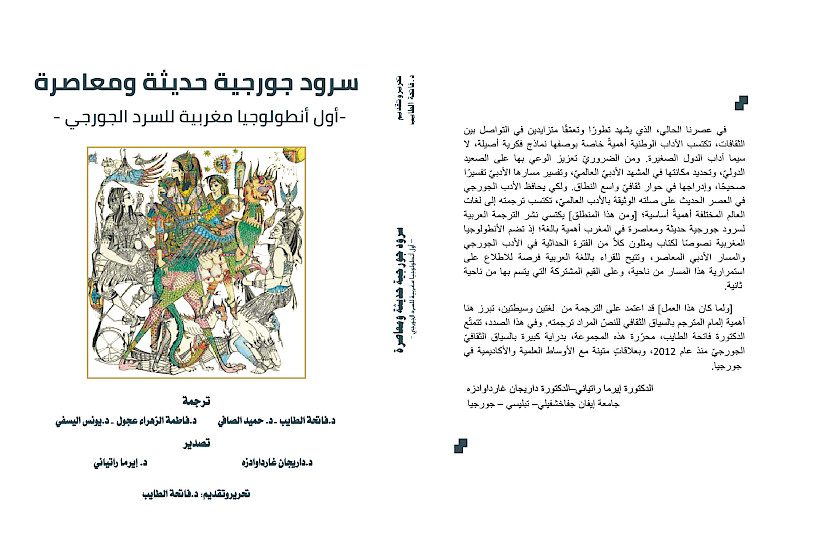
On the occasion of World Translation Day, the AILC-ICLA is pleased to present the first Moroccan anthology of Georgian narratives, which bears on its cover the name of Professor Irma Ratiani, Director of the Shota Rustaveli Institute of Georgian Literature. She is joined by her colleague Professor Darejan Gardavadze, Director of the Institute of Oriental Studies in Tbilisi and Head of the Department of Arabic Studies at Tbilisi State University, with whom she co-authored the preface. The translation was completed by [name] in partnership with three Moroccan professors of English who took part in the workshop organized by Lobna Ismail during the XXIII ICLA Congress, held in Tbilisi in 2022. The anthology is thus a direct outcome of that Congress, and a tangible example of the dialogue between literary traditions that the Association seeks to encourage.
Preface
It is highly significant that the Arabic translation of Modern and Contemporary Georgian Short Stories will soon be published in Morocco. The collection includes texts by authors representing both the modernist period of Georgian literature and the contemporary literary process. It offers readers an insight into the continuity and shared values of this process.
The history of Georgian literature spans twenty-one centuries, as the earliest literary text, "The Life of Saint Nino", dates back to the fourth century BCE. It has passed through all the important stages of the European literary process, from the Middle Ages to modernism and postmodernism.Georgian literature reached the peak of its development in almost every era. Georgian modernism was significant not only for establishing a new aesthetic, but also for resisting and becoming a victim of the Soviet totalitarian regime. Many Georgian modernist writers were punished for their civic and artistic principles. Methods used by the Bolshevik regime included the death penalty, suicide, arrest, and exile. Despite such treatment and oppression, Georgian modernism successfully fulfilled its task, leaving a rich literary heritage for Georgian and international readers. This anthology presents authors who personify this direction of Georgian literature: Grigol Robakidze, founder of Georgian modernism and a representative of Georgian expressionism; and Niko Lortkipanidze, a Georgian impressionist writer.
The collection opens with a story by Vazha-Pshavela that is an open call to humanism. The ethical and social pros and cons that Vazha-Pshavela uses as the foundation of his characters' value system transcend narrow separatist standards and delve into the profound layers of humanism. Vazha-Pshavela, a Georgian classic writer of the late realist era, summarized the essence of Georgian realism in his work and paved the way for modernist tendencies. His art is a bridge between classical and modernist Georgian literature.
A significant part of the collection is dedicated to contemporary Georgian literary figures whose artistic tastes were formed at the beginning of the 1990s after the collapse of the Soviet Union and continue to evolve to this day. They represent the postmodernist tendencies that are so prevalent in post-Soviet Georgian literature, as well as other types of discourse. Kote Jandieri’s Cinderella's Night stands out for its thematic shift from real context to psychological associations. It is an impressive story about anticipation, anger, and love, as well as the mystical complexity of life. Zaal Samadashvili's urban prose focuses on the intellectual interplay between author and reader. His text, distinguished by Tbilisi humor and warm irony, describes human relationships and everyday events with particular warmth. Mamuka Kherkheulidze addresses ongoing contradictions in the Caucasus region, offering a text filled with pacifist sentiments. David Dephi captivates with his diverse forms of expression. Zurab Lezhava's text is a naïve narrative merged with black humor, phantasmagoric images, and naturalistic narration.
The works of female authors Ana Kordzaia-Samadashvili and Mari Bekauri deserve special attention. These authors introduce the topics and interests of the 1990s and 21st century generations to Georgian literature. Their prose aligns with the general concept of feminist discourse and is less constrained by conceptual and moral clichés. Alongside the socio-psychological and autobiographical discourses, urban and erotic texts written in various styles have strengthened. These authors demonstrate an affinity with international standards as well as a distinct individuality rooted in Georgian cultural markers.
Once again, I wholeheartedly welcome the publication of this collection, and I hope that Moroccan readers will appreciate the work of Georgian writers.
Irma Ratiani
Professor at Ivane Javakhishvili Tbilisi State University
Director of Shota Rustaveli Institute of Georgian Literature
President of Georgian Comparative Literature Association (GCLA)